
Finding People with the Ann Arbor Residents Directory
Begin with the piece of information that is already reliable: a full name, an address, a time period, or a relationship to a property. In Ann Arbor, that choice points to a different custodian. The county parcel record is useful for a property question, the voter channel for status and jurisdiction, the Register of Deeds for an ownership transaction, the courts for a public case lead, and AADL for earlier households. No result should be treated as a universal profile.
- Search the county property form by taxpayer name, parcel, or the known street and municipality.
- Use Michigan Voter Information Center to corroborate current registration status and jurisdiction.
- Check the Register of Deeds index for a recorded deed, lien, or other ownership instrument.
- For an older person or address, search AADL's city and county directory editions and note the page.
- When the public view stops, send a narrow request to the custodian with the date range and record identifier.
A property taxpayer can differ from a current occupant, and a dated directory entry can differ from a current address. Compare two independent records before moving a result forward, especially where names repeat or a township and city use similar address labels.
Ann Arbor Residents Directory Records Offices
Ann Arbor addresses cross city, county, and state systems. Washtenaw County's Clerk/Register of Deeds keeps recorded land instruments and county election and vital functions. Equalization and local assessors maintain parcel and tax data. Michigan's election system maintains voter records, while city records travel through the City Clerk. Each office answers a different question, so a fast search still needs the right label for the evidence it finds.
Washtenaw County Clerk/Register of Deeds
P.O. Box 8645
Ann Arbor, MI 48107
734-222-6710
Washtenaw Equalization and Parcel Records
County property data
Ann Arbor, MI
734-222-6662
Parcel Search in the Ann Arbor Residents Directory
The Washtenaw Property/Parcel Lookup is the practical first stop for a name tied to a property or a street sweep. It accepts a 12-character parcel number, a street name without the street type, one street number or a From and To range, a city, village, or township choice, and a taxpayer name entered last name first. City of Ann Arbor and Ann Arbor Township are separate municipality choices. The form has no ZIP field because its job is parcel administration, not postal routing.
| Parcel form field | Best use | Local caution |
|---|---|---|
| Street Name | Enter the name only, such as Main | Do not add the street type to the query |
| Street Number or From/To | Find one parcel or browse a numbered stretch | Run the correct municipality first |
| Parcel Number | Match a precise county identifier | Keep it with the legal description |
| Taxpayer Name | Test a property relationship | Mailing and situs fields may differ |
The Washtenaw parcel-search screen shows the number-range and municipality route that supports a first pass.
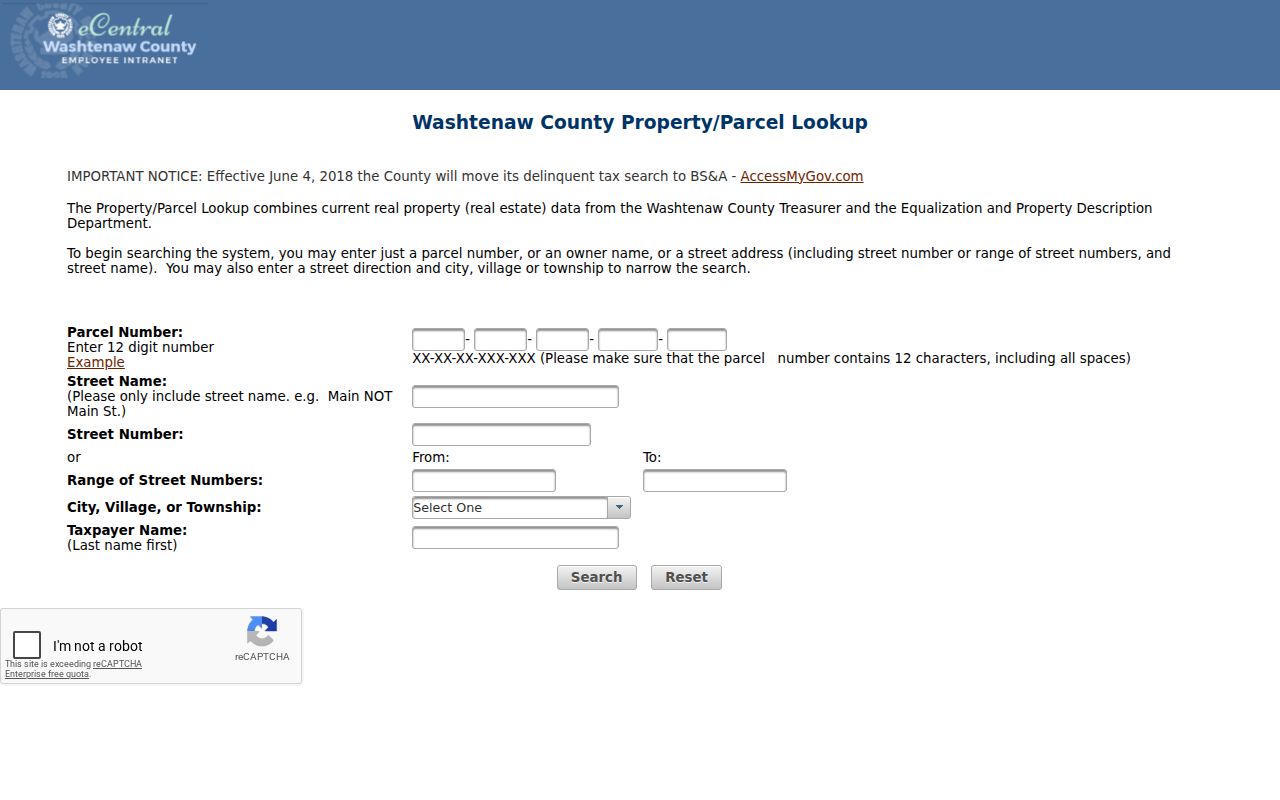
Save the parcel ID, municipality, situs address, taxpayer name, mailing address, assessment year, legal description, and report date. The county says parcel data should be verified with the local assessor, and its Principal Residence Exemption percentage is tax evidence, not a complete household list.
Situs and Mailing Fields in the Ann Arbor Residents Directory
A parcel's situs address identifies where the property is located. Its taxpayer mailing address identifies correspondence for the taxpayer. Those fields can match, but they can also point to different places for legitimate reasons. Treat a different mailing field as a lead for a taxpayer relationship, not as proof of present occupancy. The same restraint applies to an owner label, a school-district field, and a Principal Residence Exemption percentage.
Use the parcel record with a recorded deed when a title question matters. The deed is the conveyance evidence and its legal description is the strongest bridge across changed street numbers, subdivision labels, or parcel splits. For a complete address-based chain, the Ann Arbor street directory gives the deeper street-by-street method.
Michigan Voter Records in the Ann Arbor Residents Directory
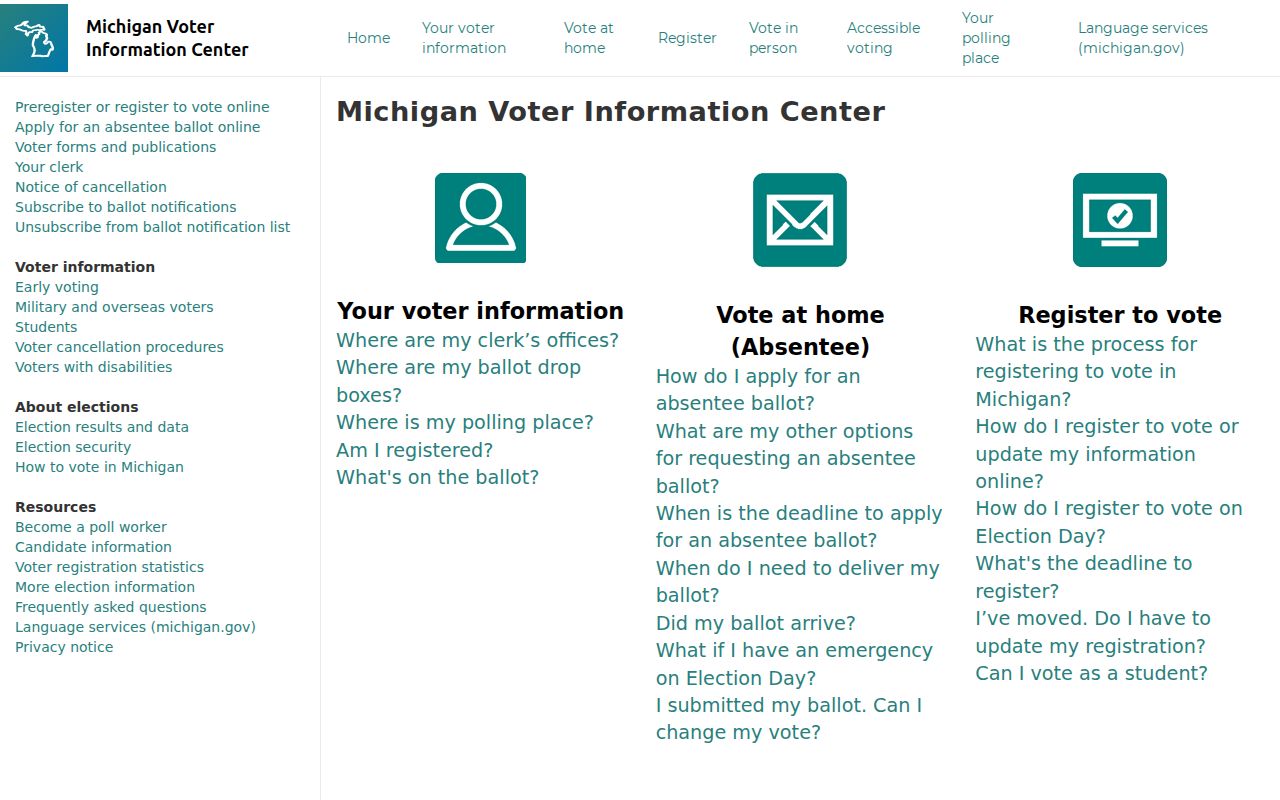
Michigan Voter Information Center is the individual status route. It can help a voter find registration status, clerk, polling location, districts, and ballot information. The Qualified Voter File is different: it is a written request for one defined geography, such as a county, jurisdiction, ward, or precinct. Its form permits voter-history requests but does not reveal ballot choices, and Michigan does not register voters by party affiliation.
The Michigan Voter Information Center page is the public starting point for a personal status check.
Michigan FOIA makes voter registration records available with important exclusions. Driver and state ID information, month and day of birth, phone, email, signature, Social Security digits, and other protected fields are not public. QVF delivery is by encrypted media, arranged FTP, pickup, or mail, not ordinary email, and a protected address must never be reconstructed from public fragments.
Court Records in the Ann Arbor Residents Directory
Ann Arbor has distinct court-search doors. The city's 15th District Court search offers name and case-number paths with public Registers of Actions. Washtenaw Odyssey separates criminal, civil, family and probate records and calendars. MiCOURT provides a statewide public layer. Use a result as a lead to compare party role, file date, status, court, and name variants, never as a conclusion based on a name alone.
The Washtenaw Odyssey public-access interface makes the separate case categories and calendar route visible.
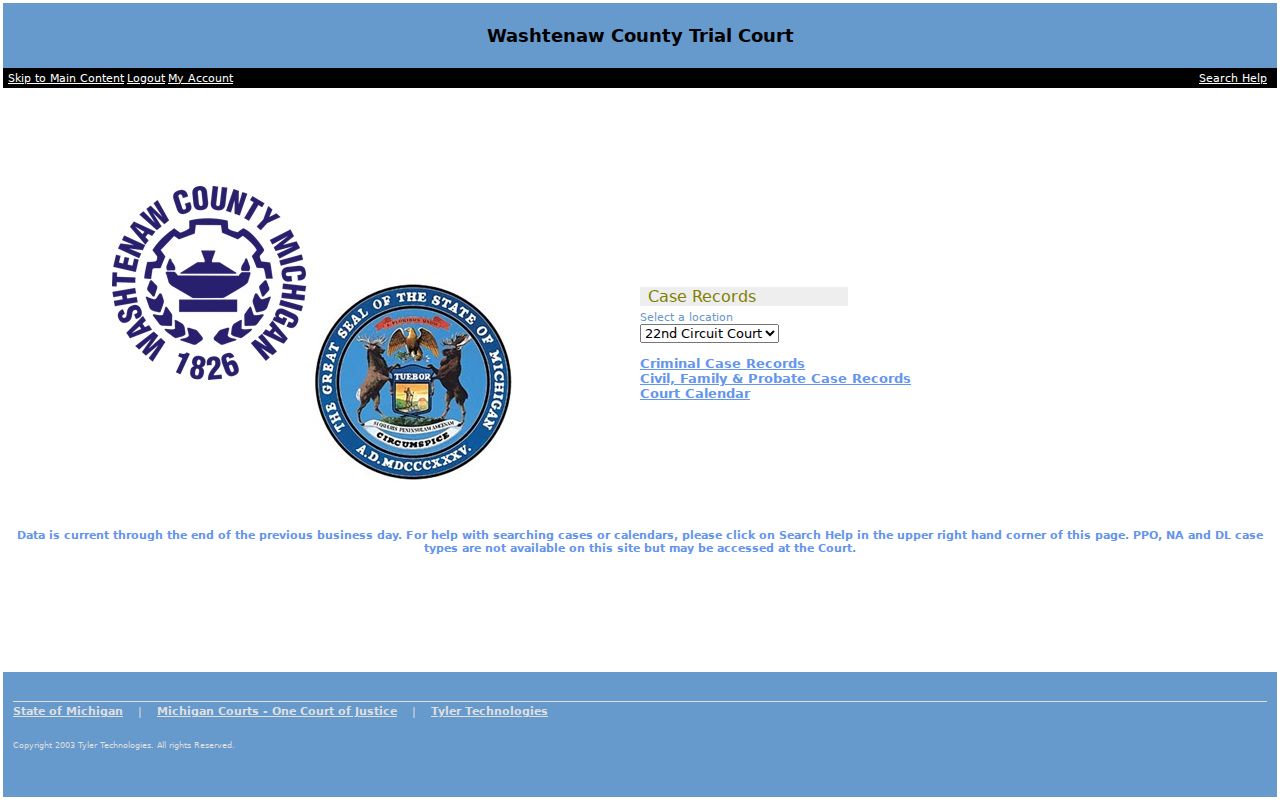
Many categories are excluded from public search, and the city reports that cases closed before August 5, 2006 in its prior system require court contact. The court of record, not the display page, is the route for copies, a public file question, or a correction.
Current Ann Arbor Residents Directory Sources
Current directory-like sources each expose a limited slice of public information. A county parcel report is best for a property record, a voter check for election status, a deed index for parties to a recorded transaction, and a public court result for a dated case lead. State license and business records can corroborate an affiliation but do not establish a personal location. Ann Arbor Planning association maps add a community boundary and contact layer, not a household roster.
| Current source | What it labels | Keeper | Access route |
|---|---|---|---|
| Parcel report | Taxpayer or owner, parcel, situs and mailing fields | Washtenaw County | Free portal, assessor verification |
| MVIC or QVF | Registration status or permitted voter fields | Michigan elections offices | Individual tool or written request |
| Land-record index | Grantor or grantee in a recorded instrument | Register of Deeds | Free index, copy login or mail form |
| License or filing | Public credential or organizational role | LARA or Corporations Division | Official state search |
| Association map | Registered boundary and primary contact | Ann Arbor Planning | Public map, not member data |
Official channels state their limits and give a correction path. Commercial people-finder services can blend old addresses, marketing information, and public data, which can create stale or same-name matches. Use a custodian or library source to prove a specific fact.
| Comparison point | Official or library source | Commercial people finder |
|---|---|---|
| Record label | Identifies the parcel, docket, directory edition, or filing that supports the result | May combine several source types into a single profile |
| Correction path | Points back to an assessor, clerk, court, state agency, or library custodian | May not control the underlying government or archive record |
| Time context | Lets the reader retain a record date, volume, page, or filing date | Can blur historical and current entries |
- Roll
- A record set maintained for one function, such as property taxation or voter registration. It does not list every person in Ann Arbor.
- Index
- A guide to a record, often naming a deed party, case, or volume location without replacing the document itself.
- Parcel
- A county property unit identified by its own number, municipality, and legal description.
- Criss-cross directory
- A historical street listing that works from an address toward a dated occupant listing.
For a property question, the official chain is especially clear: the parcel report identifies the county record, the deed index identifies the recorded instrument, and the Register of Deeds supplies the copy route. Public index searching is free through the public-user path, while online document copies require a registered login. The county mail form is the backup when a user has the names on the document, document type, liber or page, and page count. It lists $1 per page and $5 for each certified document, with no published online-index start year to substitute for a custodian check.
Permit Trails in the Ann Arbor Residents Directory
City permit research is organized by era rather than one all-time database. OnBase covers digitized microfiche and paper material from about 1930 through 2007. A2Trak holds outstanding and archival material from about 2008 through March 2022, while Stream begins with April 2021 and continues for newer applications. The overlap means a date search can require more than one city system.
A2Trak has one fuzzy Search Criteria field and supports an address, parcel ID, site description, owner, or status search. Its archived permit guidance says to omit the street type, then inspect Permit Info and Attachments for notices, reports, and certificates. Permit material can date a project, inspection, or administrative event, but it does not by itself establish who lived at an address.
Vital Records in the Ann Arbor Residents Directory
Michigan MDHHS registers and issues statewide birth, death, marriage, and divorce records, while the Washtenaw County Clerk/Register of Deeds is the local registrar for county events. State files begin in 1867 for birth, death, and marriage, and in 1897 for divorce. A birth record less than 100 years old is restricted by MCL 333.2882. Death, marriage, and divorce certified copies have a different written-request rule, and a divorce court file remains separate from the vital certificate.
The Michigan vital-record ordering page shows the application route for vital-record requests.
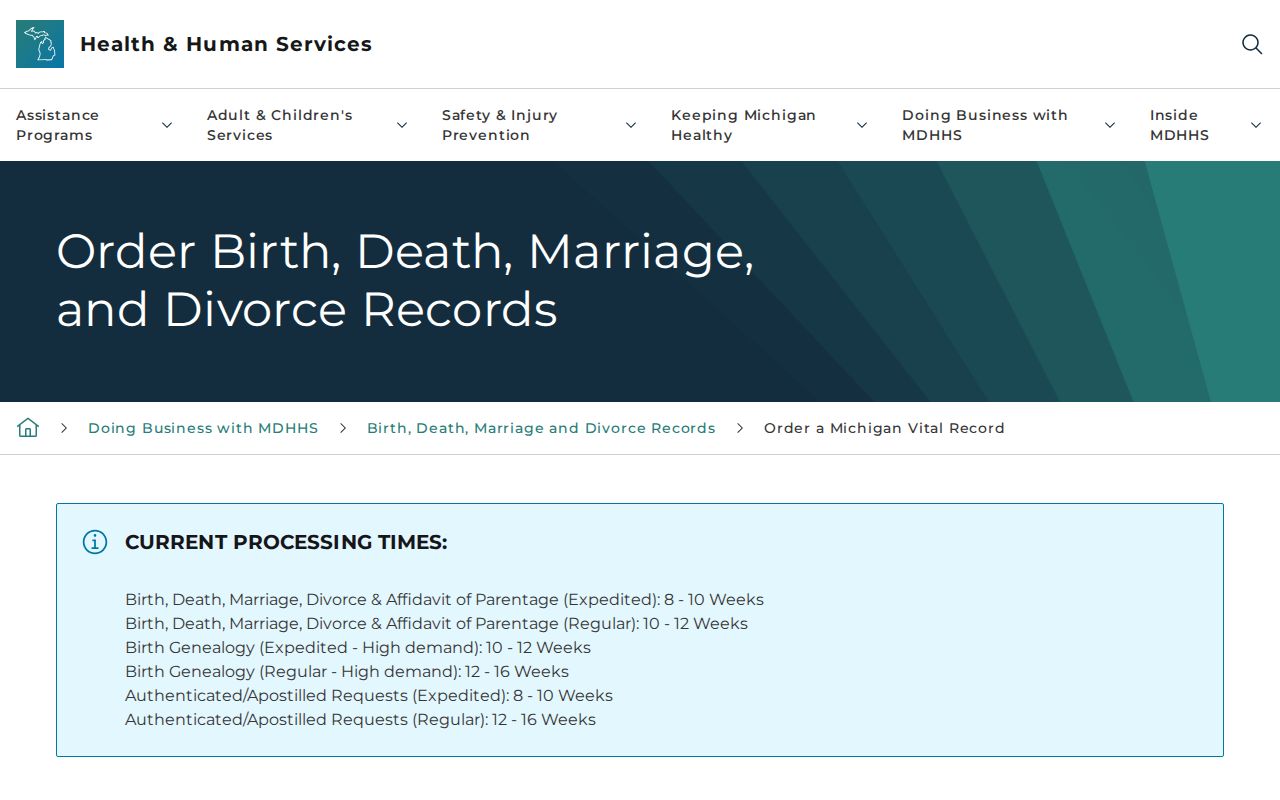
Use exact names, alternate surnames, event place, and approximate date when ordering. For a local historical fallback, the Archives of Michigan guide lists Washtenaw death index material from 1867 to 1933, marriage index material from 1833 to 1934, and a birth index for 1914 to 1922. A genealogy label does not bypass the restricted-birth rule.
Historical Ann Arbor Directory Collections
AADL's digitized city and county directory collection spans listed editions from 1868 through 2001. The earliest listed edition is Chapin's 1868 directory, followed by the nineteenth-century county and city volumes, Glen V. Mills editions in the 1890s and early 1900s, and later Polk runs. The collection is extensive but does not claim an edition for every calendar year. Search inside the scanned volume, then verify OCR text against the page image.
The Downtown Library's third-floor local-history section holds old directories, local periodicals, genealogy books, yearbooks, University directories, maps, local documents, newspapers, and microfilm. A 1915 entry can contain a name, spouse or household notation, occupation, organization, street, and abbreviations such as res, bds, or wid. Those are historical listing terms, not proof of ownership or a complete household. The full collections workflow belongs on the Ann Arbor city directory page.
Ann Arbor's directory tradition has a local story behind it. In 1898, Glen V. Mills reported plans to build a directory library by exchanging publications with publishers in Detroit and Kansas City. The modern collection is also unusually deep: AADL's Ann Arbor News holdings include clipping files for 125,000 topics, 800,000 bound newspaper pages, and 2.3 million photographic negatives. Archive staff can search a climate-controlled collection and scan selected items on request, so an email with a person, year, street, and precise clue can be more useful than a broad web search.
Township Islands and Ann Arbor Record Geography
Ann Arbor's city boundary is irregular because the city expanded around township land and islands. A mailing address can therefore need City of Ann Arbor, Ann Arbor Township, Scio Township, or Pittsfield Township context in a record search. City-initiated annexation materials describe a first round completed in 2016 and later State Boundary Commission decisions and appeals in 2021 through 2023. These changes are why parcel ID, legal description, and municipality belong together in search notes.
ZIP codes are postal geography, not municipal borders. USPS is the authority for delivery formatting and ZIP assignment; the county parcel system is the authority for its property fields; city and county GIS give boundary context. When these sources disagree, retain each source's purpose rather than forcing them into one address claim.
MapWashtenaw can help locate the parcel geometry, aerial context, natural features, topography, and connected city or county layers, but the county labels it a reference tool rather than legal evidence. Its map may show a boundary clue that leads to the correct municipality choice. Confirm the parcel's formal description with the county report, a recorded deed, or a survey before relying on a map depiction for a title or boundary question.
When Ann Arbor Residents Directory Searches Stop Online
An online gap is a routing problem. Deed images require a registered login for online purchase, or a mail copy request that identifies the document and pays the county's listed $1 per page plus $5 for each certified document. AADL's climate-controlled archive is not open for walk-in research, but staff can check inventories and digitize selected items when a request includes names, dates, context, and item clues. The City Clerk is the city-held-record fallback.
The Ann Arbor records-request page explains the city FOIA path.
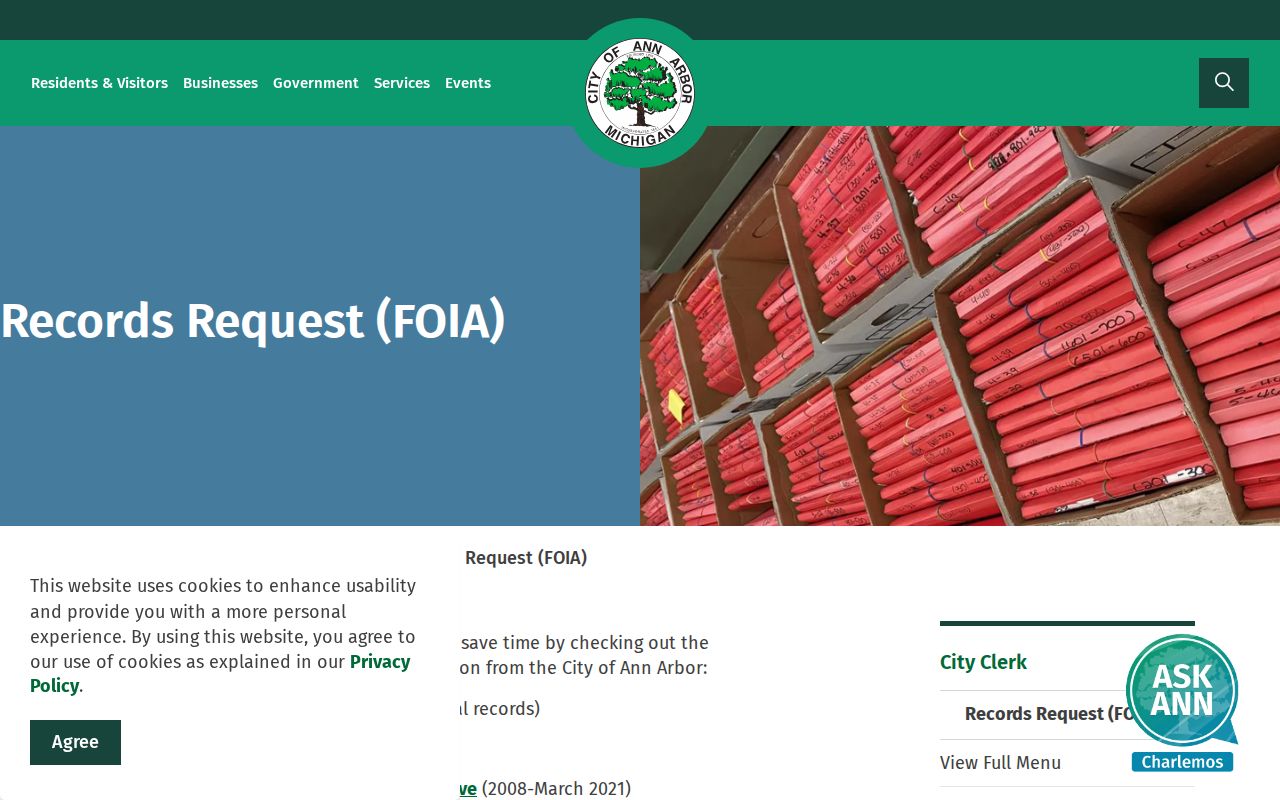
Michigan FOIA, 1976 PA 442, MCL 15.231 et seq., does not require a special city form. A written request should identify the records, provide requester contact information, and be sent by email, mail, in person, or fax. The city generally responds within five business days and may use a ten-business-day extension. Keep the request narrow and verify a response with the holding office.
City fee rules also make the request worth narrowing before it is sent. Ann Arbor generally gives the first hour of search and review without charge, then may bill in 15-minute increments at the lowest capable employee wage with the permitted fringe multiplier. The city lists $0.05 for a standard paper sheet, $12.50 for a 30 by 30 GIS print, $1 for a CD or DVD, and a possible 50 percent deposit when an estimate exceeds $50. A correct office, a short date range, and a known parcel, case, or document number reduce both delay and ambiguity.
Lawful use. Use public records for personal, lawful research, family history, estate questions, civic transparency, or source verification. Do not use any record trail to stalk, harass, intimidate, or harm a person.