
Ann Arbor City Directory Collections
The Ann Arbor District Library City & County Directories collection is the main starting point. AADL says its digitized collection spans listed editions from 1868 through 2001. The browser can search within scanned volumes, browse the edition list, and download PDFs. That range is broad, but it is not a promise of one edition for every calendar year. A missing item in the listed run is a collection gap, not evidence that a person left town. Downtown print copies and related holdings at the Library of Michigan, Bentley Historical Library, and HathiTrust provide other places to continue the search.
| Collection | Years | Where Held | Access |
|---|---|---|---|
| Ann Arbor and Washtenaw city directories | 1868-2001, listed editions | AADL online and Downtown Library; selected copies at Bentley, HathiTrust, and Library of Michigan | Free searchable and downloadable PDFs; in-person print |
| Chapin, Cole & Keating, county and early Polk volumes | 1868-1892 listed editions | AADL directory collection | Edition browsing and scanned PDFs |
| Glen V. Mills directories | 1894-1905 listed editions | AADL directory collection | Searchable scans and PDF viewing |
| R. L. Polk and later county directories | 1908-2001, listed editions | AADL, with Library of Michigan print or microfiche examples | Online scan or library access |
| Sanborn maps and federal census microfilm | Maps 1888-1948; census 1830-1930 | AADL Downtown Library | Microfilm and local-history research |
Use the edition title as part of the citation. Early volumes include Chapin's 1868 directory and Cole & Keating's 1872 directory. County-wide titles appear in the 1880s, and some later books include Ypsilanti or rural routes. Those scope changes matter. An Ann Arbor result may sit in a directory with a wider Washtenaw audience, while a county result may not describe city residence.
The AADL Downtown Library page shows the local-history setting behind the collection.
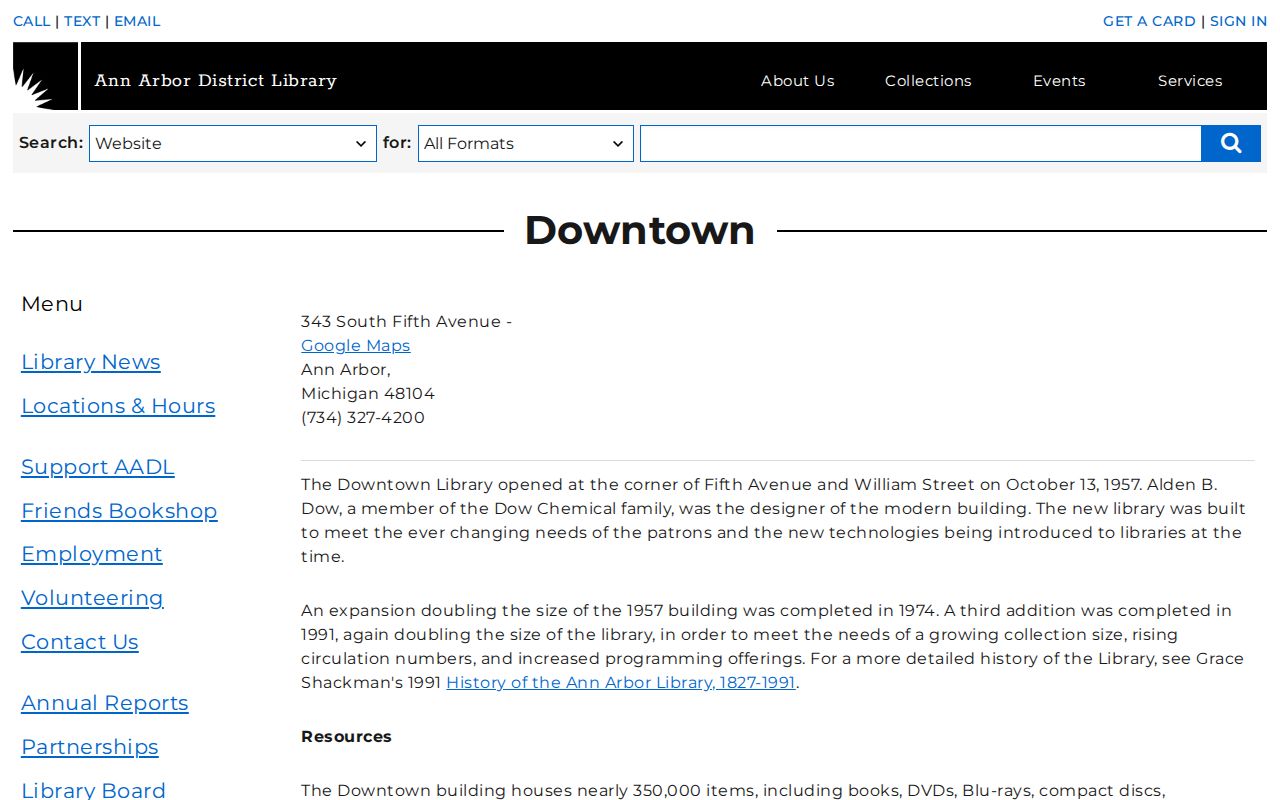
The third-floor holdings put directories beside newspapers, maps, yearbooks, government documents, and genealogy references, which makes it easier to test a dated directory entry against another local source.
Ann Arbor City Directory Editions
Publisher changes help identify the right book. AADL lists Glen V. Mills editions for 1894 through 1905, with some years absent from the list, followed by R. L. Polk volumes from 1908 onward. The Polk run includes annual books through 1942, an Ann Arbor-only 1943 listing, then selected later editions through 2001. A researcher should open the edition instead of assuming that a publisher name, city coverage, or street-list format carried over unchanged. OCR can misread surnames, street directions, and abbreviations, so every text hit needs a check against the scanned page image.
| 1868 | Chapin's City Directory of Ann Arbor is the earliest listed AADL edition. |
|---|---|
| 1872 | Cole & Keating issued an Ann Arbor city directory. |
| 1883-1892 | County, Ann Arbor, Ypsilanti, and early Polk titles appear in the listed sequence. |
| 1894-1905 | Listed Glen V. Mills editions form a distinct local publishing period. |
| 1908-2001 | Polk and later Ann Arbor-Washtenaw editions appear in the digitized run. |
Note: Save the publisher, edition year, page, and scan link because a keyword match alone can be hard to reproduce.
Reading an Ann Arbor City Directory
The inspected 1915 R. L. Polk volume is a useful example of how much a compact entry can carry. It may give a surname and given name, a spouse or other relationship in parentheses, an occupation, an organization, a residence marker, and a numbered street address. Some entries add a telephone or business address. The volume also has alphabetical names, classified business listings, and street listings. The street portion can work as a reverse directory for that edition, but it still records a dated listing, not a complete roster of everyone at an address.
| Name and relation | A surname and given name may be followed by a spouse or household relation in parentheses. |
|---|---|
| Occupation or affiliation | An entry can name a role, employer, business, institution, fraternity, church, or public office where printed. |
| Residence | res marks a residence listing and is followed by the street number, street name, and sometimes a direction. |
| Boarding | bds identifies boarding. It does not establish a family relationship or ownership. |
| Widow notation | wid followed by a name is a widow notation, a valuable but dated family-history clue. |
- Criss-cross directory
- A street-ordered directory that lets a reader move from an address to a listed occupant for that edition.
- Householder index
- An index organized around the listed household name, rather than every possible resident.
- Abbreviation key
- The front-matter list that explains short forms such as res, bds, compass directions, and occupation terms.
In the 1915 directory, an address after res is evidence of a residence listing, not proof of title. A business address can look like a home address, and a boarder can appear without the rest of the household. Copy the abbreviation key before interpreting unfamiliar marks. It is also wise to search both a normalized spelling and the spelling printed on the page.
Ann Arbor City Directory Research at AADL
The Downtown Library at 343 S. Fifth Ave. keeps its local-history section on the third floor. Its documented holdings include old city directories and phone books, high-school yearbooks, University of Michigan directories, maps and atlases, local government material, historic newspapers, and microfilm. The online directory viewer is the fastest first pass. When a scan is unclear or an item is not online, the library shelf and microfilm provide a second route. AADL's archive facility itself is climate-controlled and not open for walk-in use, but staff can search inventories and digitize selected material when a request gives a name, date, context, and item clue.
Send an archive fallback request to archives@aadl.org. The AADL research guidance also advises using a stable keyword and avoiding quotation marks when searching local-history material. For community history beyond the library catalog, the Washtenaw County Historical Society is another local-history contact point.
The Washtenaw County Historical Society landing page provides a local-history research lead.

Use a directory's date and page number when contacting a repository, so a question about a person, address, or event stays tied to the exact historical source.
Glen V. Mills' Ann Arbor Directory Library
A 1898 newspaper notice gives the directory collection a particularly local origin story. Glen V. Mills reported receiving directories from Detroit and Kansas City after publishers agreed to exchange publications, and he planned a directory library for Ann Arbor. The notice does not turn every surviving book into a complete census. It does show that directory exchange and library building were already part of the local information network long before digitization.
That history helps explain why the Ann Arbor city directory collection includes differing publishers and wider county titles. Treat the publisher and scope printed on the title page as part of the record, especially when following a name across a change from an Ann Arbor volume to a Washtenaw directory.
Trace Families with Ann Arbor City Directories
A dated address is the bridge between a name search and a household trail. Start with the first entry that has enough distinguishing detail, such as a spouse, occupation, or exact street direction. Then compare nearby editions rather than jumping straight to a distant year. A move, a new widow notation, a change from residence to boarding, or a new business address can narrow the next search. Pair the annual-style directory evidence with a census-year household snapshot, deed or parcel material, and a newspaper notice where those sources fit the question.
- Find a name or address in one AADL edition and record its title, publisher, year, page, spelling, and street direction.
- Check editions one or two years on either side for moves, spouse changes, occupation changes, or a disappearance.
- Open the street listing for the same edition to see the address context and preserve the page citation.
- Compare the dated result with federal census years. AADL has Washtenaw census microfilm through 1930, while the federal public-release rule makes 1950 the latest complete census currently public.
- Use an obituary, marriage notice, probate source, or deed record to test a change, without treating the directory alone as proof of ownership or family membership.
A name missing from a volume can mean many things: an edition may be absent, the OCR may have failed, the person may have moved, or the compiler may not have listed them. Keep the uncertainty in the research notes. For a current street-by-street property trail, use the separate Ann Arbor Street Directory rather than reading a historic address as a modern result.
Ann Arbor City Directory Companions
City directories become stronger when they are paired with materials that answer a different question. AADL has Sanborn Fire Insurance Maps on microfilm from 1888 through 1948. The Library of Congress has digitized Ann Arbor map editions including 1888, 1892, 1899, 1908, 1916, and 1925. Maps can show the physical setting of an old address, while the directory supplies a dated occupant or business listing. They should not be used to infer an unlisted person.
AADL also provides local high-school and college yearbooks, with an online high-school yearbook collection covering 1884-1923, and University of Michigan student directories can supply a local address or telephone for enrolled students. Bentley notes that many Ann Arbor city directories have been scanned into HathiTrust. These sources are useful companions when a household includes a student, but preserve the academic or directory year because that address may have been temporary.
Ann Arbor City Directory News Trail
News can help test whether a household change in an Ann Arbor city directory reflects a death, marriage, business event, or move. AADL says the Ann Arbor News is digitized back to 1923 and is searchable through the Library of Michigan card route to NewsBank for Michigan residents. The physical archive adds clippings, bound newspapers, and photo negatives, but it is not a walk-in archive. For a scan or a hard-to-find clipping, use the archive-email route with the directory year, name, street, and context.
Local periodical access is still expanding. In 2025 AADL announced plans to acquire the Ann Arbor Observer, building on digitized Observer material and related City Guides and Art Fair Guides. That material can add neighborhood or event context, but the dated directory entry remains the direct source for the printed name-and-address listing.
Note: A newspaper date may confirm an event near a listing date, but it does not erase the need to verify names and addresses against the original page image.