
Ann Arbor Previous Residents by Era
Different sources hold different parts of the past. A deed is the best record for a conveyance and legal title. A directory captures a named listing at an address in one edition. Census schedules show a household at a decennial moment, while permits and Sanborn maps help date work or a building footprint. The sources below form a practical era map for tracing past residents of one Ann Arbor address. A gap in one source is a cue to change record type or access channel, not evidence that no one was there.
| Address-history source | Verified period | Where it is held | What it can show |
|---|---|---|---|
| Deed index and historical books | Current online index; online start year not published | Washtenaw Clerk/Register of Deeds | Recorded ownership instruments, grantor/grantee, legal-description trail |
| Ann Arbor directory street listings | Listed editions 1868-2001 | AADL online and downtown print | Annual address listing, occupation, and household notation when printed |
| Sanborn maps | AADL microfilm 1888-1948 | AADL and Library of Congress | Building footprint, use, and construction or alteration clues |
| Federal and Michigan census material | Federal public releases through 1950; state snapshots 1827-1894 | AADL and Library of Michigan | Household composition and interim resident snapshots |
| Permit systems | About 1930 to present, divided by platform | Ann Arbor city records | Project, inspection, plan, or administrative activity dates |
| Probate and local news | Probate files 1828-1940; News digitized back to 1923 | Archives, court, AADL, and Library of Michigan | Estate, death, heir, move, and community-event leads |
Start with the current parcel and deed when the goal is a continuous address trail. Start with an edition and census year when the goal is a particular historical household. For all prior residents, record what the source proves and what remains unconfirmed.
Start Ann Arbor Records With Parcels
The current Washtenaw Property/Parcel Lookup is the first bridge into an older Ann Arbor address. Search by parcel number, street number and name, a number range, municipality, or taxpayer name entered last name first. Enter a street name without its type. Select City of Ann Arbor rather than Ann Arbor Township when that is the correct jurisdiction. The form does not offer a ZIP field, so a postal code is not the right key for property history.
| Keep from the parcel report | Parcel number, municipality, situs address, taxpayer name, taxpayer mailing address, legal description, assessment year, PRE percentage, and report date. |
|---|---|
| Use carefully | A mailing address is tax correspondence, not proof of occupancy. PRE is a tax exemption detail, not a household list. |
| Why it matters | The parcel and legal description can survive a changed number, a split, or a municipality-label difference. |
The parcel report also separates sales-history information such as liber-page, sale date, instrument, and sale price. Use the recording reference to locate the deed, then compare the legal description. Do not treat a current parcel snapshot as proof of when the building received its present address or who was present during an earlier year.
Trace Ann Arbor Previous Residents by Deed
Ownership history starts with the recorded instrument, not an address alone. The Washtenaw online land-record search provides free public index access. Find the current owner as grantee, capture the document details, then follow the seller as an earlier grantee. Search alternate spellings, initials, married names, trusts, and entity names. A grantor can be a person, estate, fiduciary, or organization, so the legal-description comparison is the control that keeps a same-name result from joining the wrong parcel.
- Save the current parcel number, municipality, taxpayer record, and legal description from the county report.
- Find the current owner's purchase record in the Register of Deeds index and write down the grantor, grantee, instrument, recording date, and liber/page or document number.
- Use the prior grantor as the next earlier owner, then search that person or entity as grantee in the earlier period.
- Repeat the sequence, checking the lot, block, subdivision, and legal description each time an address or name changes.
- When an image is needed, use a registered online login or the county copy-request form. Copies are $1 per page, with $5 added for each certified document.
- Grantor / grantee
- The grantor transfers an interest in the instrument. The grantee receives it.
- Chain of title
- The linked sequence of recorded ownership instruments for the same legal property.
- Legal description
- The lot, block, subdivision, metes-and-bounds, or other formal property description that ties a deed to land more reliably than a street number.
The county has not published a verified start year for the online index. If a needed record is not found online, the next route is the Register of Deeds copy process or an office inquiry using names, document type, date, and known recording placement.
Keep Ann Arbor Address Records Intact
Address continuity can break in Ann Arbor because parcel numbers split, municipality labels change, and city boundaries include township islands. A ZIP is delivery geography, not a property jurisdiction. Preserve the current and old parcel identifiers, street direction, lot or subdivision wording, and municipality selection together. When an old address no longer matches a current form, search the legal description, plat, cross street, or adjacent parcels before deciding the trail has failed.
Ann Arbor's annexation history makes this especially important. The city completed one island-annexation round in 2016, and later State Boundary Commission decisions continued from 2021 through 2023. Those changes can alter the governmental label attached to an address without erasing the underlying property. A specific citywide renumbering year was not found in the research, so no single renumbering date should be assumed.
Use Ann Arbor Directories for Past Residents
AADL's digitized Ann Arbor and Washtenaw directories offer listed editions from 1868 through 2001. They are annual snapshots when an edition exists, not a continuous census. Find an address in a street section, then preserve the edition, publisher, page, spelling, directional, and any residence or boarding notation. “Res” marks a residence listing, while “bds” marks boarding. Either can be a useful historical clue, but neither certifies ownership or a complete household.
For a focused request when the scan or edition does not answer the question, AADL's archives research guidance asks for a person, date, street, context, and clue already found. Its archive is not a public walk-in browsing room, while the downtown local-history area holds directories, maps, newspapers, yearbooks, and microfilm. The collection itself is covered on the Ann Arbor city directory page.
See the Archives of Michigan county-guides page used for this previous residents image.
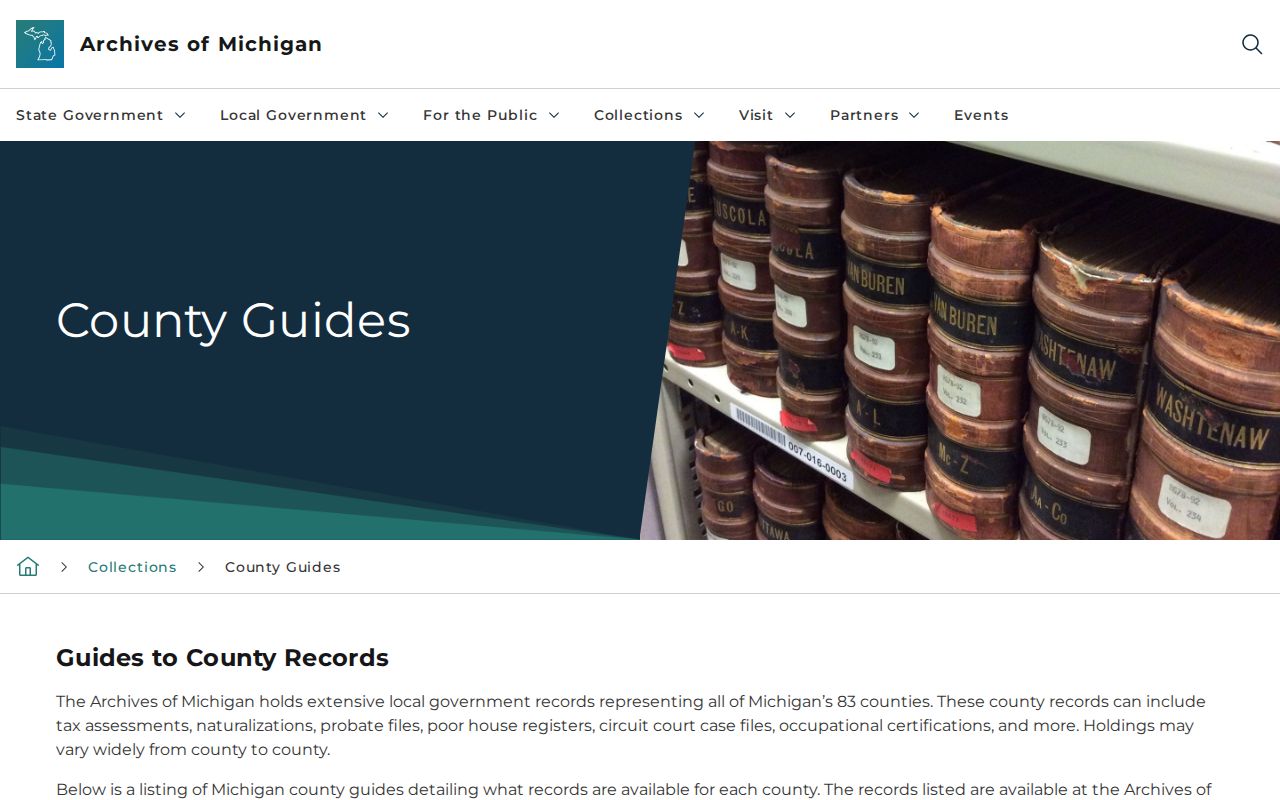
The county-guide route adds probate, naturalization, tax, military, and other dated record groups when a directory listing needs a second source.
Pair Ann Arbor Directories With Census Years
Directories and census schedules answer different parts of an Ann Arbor past-resident question. A directory can show a street listing close to a move. A federal census records household composition at a decennial point. AADL has Washtenaw federal census microfilm from 1830 through 1930, while public federal releases currently extend through 1950. Michigan state census material adds 1827, 1834, 1845, 1850, 1870, and an 1894 index through the Library of Michigan.
- Choose a directory edition near the target year and copy the exact street spelling, direction, page, and named listing.
- Compare nearby editions for a move, a changed spouse or widow notation, boarding status, or a new address.
- Match the dated directory evidence to the nearest public census year, using cross streets and household relationships rather than assuming modern address conventions.
- Save the census enumeration district and page with the directory edition so another researcher can retrace the comparison.
Note: A census address convention can differ from a directory, so a matching surname alone is not enough to merge two household records.
Date Ann Arbor Records With Sanborn Maps
Sanborn fire-insurance maps add physical context to previous residents research. AADL holds Ann Arbor Sanborn microfilm from 1888 through 1948. The Library of Congress has digitized local editions including 1888, 1892, 1899, 1908, 1916, and 1925. A map can show a building footprint, use, materials, or a changed street pattern. It can help explain why an address appears differently across directory years, but it does not name every occupant.
Use the map sheet number and edition date beside the parcel and directory notes. When a directory has only a cross street, named building, or obsolete number, compare the map with a plat and legal description. The best conclusion identifies the evidence as a building or address clue, rather than assigning a person to a parcel solely from map placement.
Date Ann Arbor Permit Records
Permit files can date an alteration, inspection, or project at an Ann Arbor address. They can list an owner or contractor label, but that is an administrative connection, not a statement of who lived there. Search the City of Ann Arbor's systems by era: OnBase contains material from about 1930 through 2007, A2Trak covers 2008 through March 2022, and Stream covers April 2021 to the present. The overlap means a narrow date range and a project number are better than a broad address assumption.
If the online systems do not return the needed item, use the city's records-request and FOIA page with the address, date range, and any known permit number. Preserve the permit or project number, owner or contractor label, issue or inspection date, and attachment name. This provides a dated activity trail without turning a project record into occupancy proof.
Close Ann Arbor Records With Probate
Obituaries and probate are useful endpoints for a historical address trail. AADL and Library of Michigan access can support Ann Arbor News searching back to 1923, while older local holdings require library or archive work. The county guide places Washtenaw probate estate files in 1828-1889 and 1889-1940, with calendars from 1842-1941. Search a death notice first, then test public probate calendar and estate-file clues against deeds recorded after the death date. Sealed or confidential court portions remain unavailable.
View the Library of Michigan Washtenaw County guide used for this Ann Arbor previous residents image.
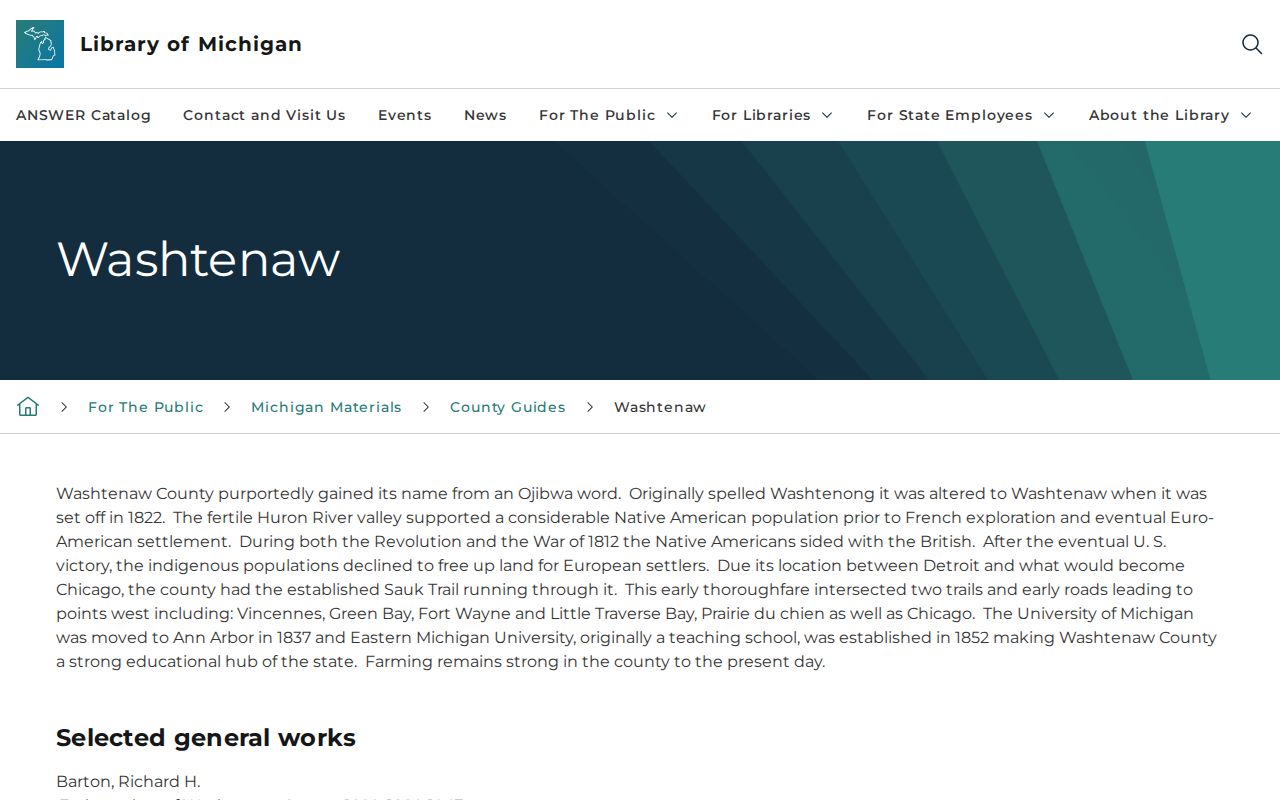
The guide identifies directories, state censuses, plats, newspaper runs, cemetery works, and county-specific holdings that can supply the next documented step.
For physical archival material, consult the Archives of Michigan visit information before travel and prepare the county, date range, record group, and known citation. A source that ends at a death or estate transfer is still a lead, not a complete family directory.
Limits on Ann Arbor Previous Residents
Past residents research has natural limits. A deed traces title, not daily presence. A directory records a listing in a particular edition, not every person at an address. A permit dates administrative activity, and a map dates a physical depiction. Older records can use different spellings, directions, municipality labels, or parcel identifiers. When a source stops, keep the stopping point and ask the appropriate custodian for a record identified by date and known reference.
Lawful use. Ann Arbor previous residents research is for family history, house history, estate questions, and personal curiosity. Do not use a historical address trail to stalk, harass, intimidate, or harm anyone.